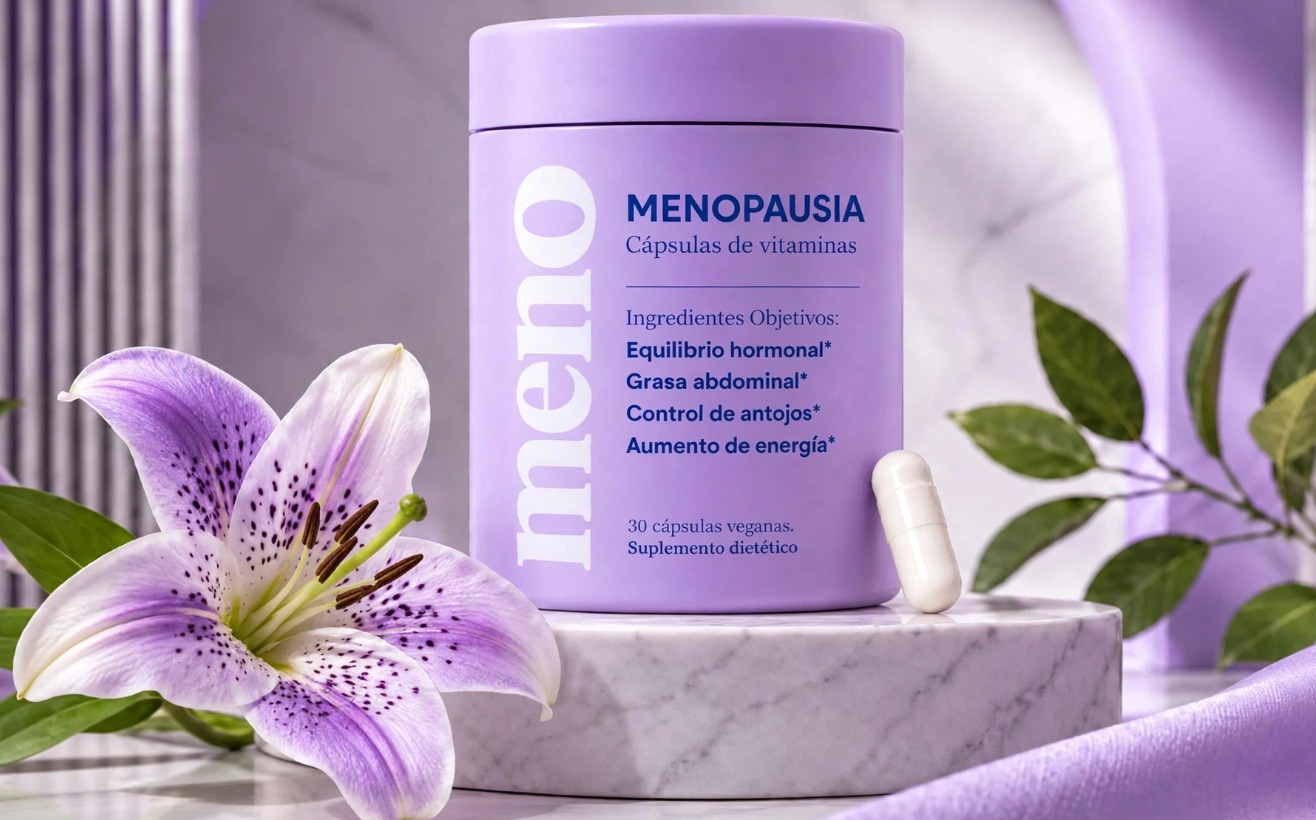
Dietary supplements are riding a wave of popularity, yet the category is fraught with shortcomings. Following the transfer of Argentina’s INAL (National Institute of Food) from the National Administration of Medicines, Food and Medical Technology, ANMAT, to SENASA, the National Food Safety and Quality Service, such products have been left in an administrative limbo. Pharmabiz looked into the case of ‘Meno‘, a recently launched product targeting the menopause, as a case study.
A dietary supplement called ‘Meno‘ has been gaining significant traction on social media in Argentina with its claims to alleviate menopause symptoms. But Pharmabiz has been able to identify that it appears to be an attempt to take advantage of the success of a product developed in the US by OPositivHealth, a company founded by the siblings Brianna and Bobby Bitton. See website
The Argentine ‘Meno‘ turns out to be a dubious copy apparently designed to tap into the furor on TikTok and other social media platforms generated by the original, which has had success among a growing market of menopausal consumers seeking products to improve their quality of life. See Forbes article
It’s sowing confusion from its own Instagram profile by referring to a «fake Meno» and an «original Meno». Yet, the product is supposedly made by Santa Coloma, a third-party manufacturer that, in the space of four years, has gone from producing fruit jams to botanical products and isn’t recognised as a player in the supplements sector. See Instagram | See Video
Twenty weeks ago, the Argentine Meno reached out to content creators. Since then, various accounts, many with fewer than 2,000 followers have been commenting on the supposed benefits of the product. Some of these accounts have since been deleted, and comments from several actual customers point to a complete lack of results.
In theory, the product is a dietary supplement, yet it’s marketed as «approved by the ANMAT» despite the fact that such an endorsement has never been part of the food and medicine regulator’s purview. Under the administration of Javier Milei, as with previous presidents, supplements in Argentina only require approval at the local level from the provinces or the City of Buenos Aires. Historically, the ANMAT’s involvement was limited solely to regulating imports.
This was just the first of several inconsistencies that emerged when Pharmabiz looked into the product. The brand, which has no identifiable company or recognised public face behind it, claims that the product contains Peruvian maca, soy isoflavones, inositol, silicon dioxide, magnesium, reishi, carnauba wax, microcrystalline cellulose, and other ingredients. But the social media posts immediately raise doubts. Encouraging consumers to purchase exclusively through e-commerce channels, they promise that users can «lose weight easily and quickly with just two capsules a day.»
Such a claim directly contradicts the regulatory scope for dietary supplements, which, under the Argentine Food Code, cannot be marketed as weight-loss aids or curative agents, and must not claim to offer «quick and easy» results. The product is available for purchase through the brand’s own online store and via the ecommerce giant MercadoLibre, priced at ARS $49,990 (approximately USD$32) for 60 capsules. See Instagram post.
As far as Pharmabiz could ascertain, the product is being marketed by an obscure firm called Renace Labs, a limited liability company (SRL) established nine months ago with ARS$5 million (USD$3,204) in capital. It was founded by three individuals in their twenties, hailing from geographically disparate locations: two are from Laguna Larga, Córdoba, and the third is from Banfield, in the Greater Buenos Aires area. The company’s registered tax address is located at Otamendi 95, in the Almagro neighborhood of Buenos Aires. See Official Gazette entry for Renace Labs
The three individuals are Valentina Carmona and Máximo Tartufoli Biazzi. Santiago Alfredo Rodoni, from Lomas de Zamora, is listed as the manager, holding a 50% stake in the company. Rodoni’s situation is particularly curious: despite being the purported «entrepreneur» behind a brand that’s gaining traction and running advertisements on social media, he has no professional digital footprint. There’s no LinkedIn profile, no photograph, and no «About Us» section on the company’s website, standard features for any serious business.
This leads to suspicions that a straw man was used to rapidly set up a logistics-focused limited liability company (SRL) and a consulting-focused simplified joint-stock company (SAS). A check of the trademark registry at the INPI (National Institute of Industrial Property) reveals that the registered owner is Facundo Moyano – no relation to the well-known Argentine trade unionist, but another individual in his twenties with no commercial track record. In any case, Pharmabiz has verified that the trademark application has been denied for now.
A ghost manufacturer
As for the contracted manufacturer, Santa Coloma, its owners are named as Luis Santa Coloma and Gladys María Iarruye. Consistent with the entire setup, the company has no website, and its owner has no public profile or commercial history.
The situation became even more dubious when a Pharmabiz reporter visited the address provided by Santa Coloma: the location where the product is supposedly manufactured. At 855 Einstein Street, in the Nueva Pompeya neighborhood of Buenos Aires, the reporter found a locked gate and missing doorbells. Neighbours said there had been no sign of activity at the site for some time. See Official Gazette entry for Santa Coloma | See supposed factory
This raises the question: where are the Argentine Meno supplements actually being manufactured? Ultimately, it appears to be a product with an opaque supply chain relying on third-party manufacturing and a regulatory system that’s currently in limbo.
Regulatory limbo
Through its independent investigation, Pharmabiz has determined that consumers of dietary supplements in Argentina are currently left completely unprotected, at least within the capital. Meno declares an RNE (National Establishment Registry) number from the Autonomous City of Buenos Aires (CABA), but consumers have no way to verify this. Unlike other jurisdictions in Argentina, the capital district has no public database of registrations.
The City of Buenos Aires also never joined SIFeGA (the Federal Information System for Food Control Management). This was established in 2014 under the auspices of ANMAT and allows for the verification of product registration and authenticity. See SIFeGA
Consequently, there’s no traceability. The product displays an RNE and an RNPA (National Food Product Registry) number on its label, but the jurisdiction that supposedly issued the authorizations provides no public portal to validate their status. This means the only remaining option is to file a formal request for public information. Pharmabiz submitted such a request to the relevant authority on Wednesday, October 21, but it has yet to receive a response.
Thus, as of the time of this report, it has not been possible to verify whether RNE 01002131 is currently valid for supplements, or if RNPA 01054823 is indeed registered to Meno. A separate issue concerns the potential transfer of INAL from ANMAT to SENASA – a move that has not yet materialized. In any case, such a transfer would not extend to the regulation of the dietary supplement segment, an area that has been unregulated since well before the Milei administration. See CABA register | See article in Spanish
Meno’s «owners»
Another point of concern is that Renace Labs is registered as a logistics and transport company that also claims to be authorized to sell supplements. In other words, it is not a drugmaker in the strict sense, nor is it a pharmaceutical distributor or a healthcare company.
It should also be noted that Rodoni is involved in another entity, Nexora Capital, which was established five months after Renace Labs. In that venture, Rodoni is partnered with Pedro Gustavo Duarte Paganetti. It appears that over the course of five months, he set up two very different companies: one focused on logistics/supplements and the other on consulting/capital with two different partners: one from Córdoba and the other from Buenos Aires (CABA).
USD $1 = ARS $1.560,40 (BCRA Monday 26/10/26)